Signing up one person did not test a shared home.
I asked for a household of four, then three separate people joining it.
Creating a household is only the beginning of onboarding. A shared product still has to work when the next person arrives, uses an invite, and sees the group’s existing state.
I asked for the whole sequence: one person creates a household of four, then three separate accounts join. That scenario forces the interface, invitations, membership state, and task ownership to meet.
See the original requestInside the screen
A disabled button needs an explanation.
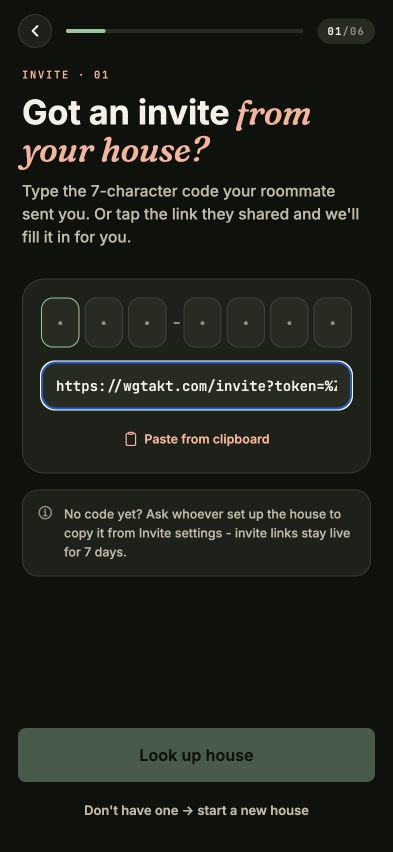
This later malformed invitation example shows why I need to test more than the first successful signup.
Select a detail
The invitation field contains a malformed link. I want to understand what the app accepts before assuming the person knows whether to paste a code or a whole URL.
General invitation help is visible, but it does not clearly explain this particular malformed value. I would make the next corrective action easier to identify.
Look up invite cannot be used here. That protects progression, but the reader still needs to understand what to change so the button becomes useful.
September development fixture using a malformed link. It does not show four completed household accounts or establish a backend invitation failure.
The original request27 Jul 2026 · excerpt
test out creating a wg of 4 then 3 separate accounts and see if it all works smooth as members join and the invite code
Excerpted from the development conversation. Punctuation is lightly edited; the surrounding story is an edited retrospective.
01
One successful login would not answer my request.
The scenario I asked for was a group forming over time. The first person creates a home. Someone else sees an invitation, confirms the household, and joins. Then two more people arrive. Each arrival changes membership while the household already contains work. A test that only creates the first account misses the part that makes this a shared product.
The membership refresh and ownership rule were therefore central. Existing assignments stayed with their current owners while later turns could include the new members. That prevents the invitation flow from silently moving work between people. I want the newcomer to understand where they have arrived, and the existing members to recognise the home they already set up. The code joining an account to a household is only one part of that experience.
02
Joining is a state transition
The recorded work included a reusable seven character invite code, a household preview before membership, display names, and membership refresh in the app. The invitation is not just a string to copy; it is a route into a specific shared state.
The ownership rule also mattered. Existing tasks stayed with their current owners, while future turns could be shared with new members. Joining should not silently rewrite responsibility for work already assigned.
03
The awkward invitation is the one worth trying.
The later development capture shows an invalid invitation input. It is useful because it preserves a state that a tidy welcome screen can avoid. People paste links, copy partial codes, and open invitations in different contexts. The app needs to make it clear whether the input identifies a home before it asks someone to become a member.
The July record did not establish the full four account production walkthrough. That required separate verified accounts and the authentication steps to use them. The local implementation and automated checks were real progress, but they did not remove that remaining scenario. My next acceptance check would follow all four accounts independently and inspect the household after each join. It would also verify that a malformed invitation never creates membership by accident.
Joining the home is the beginning of a shared interaction flow. I return to that question in Making the navigation smaller made the collision worse.
Where this chapter landed
What changed.
The four person onboarding slice was implemented locally. The dated handoff did not claim a production release or complete visual verification.
Added while revisiting this story · September 2026
The thinking behind the detail.
Research notes to take these decisions further. These sources were reviewed for this retrospective.
Explain the invitation input
W3C notes that instructions help people enter information correctly. An invitation field benefits from explaining the accepted input before an error, then keeping recovery specific when the value is invalid.